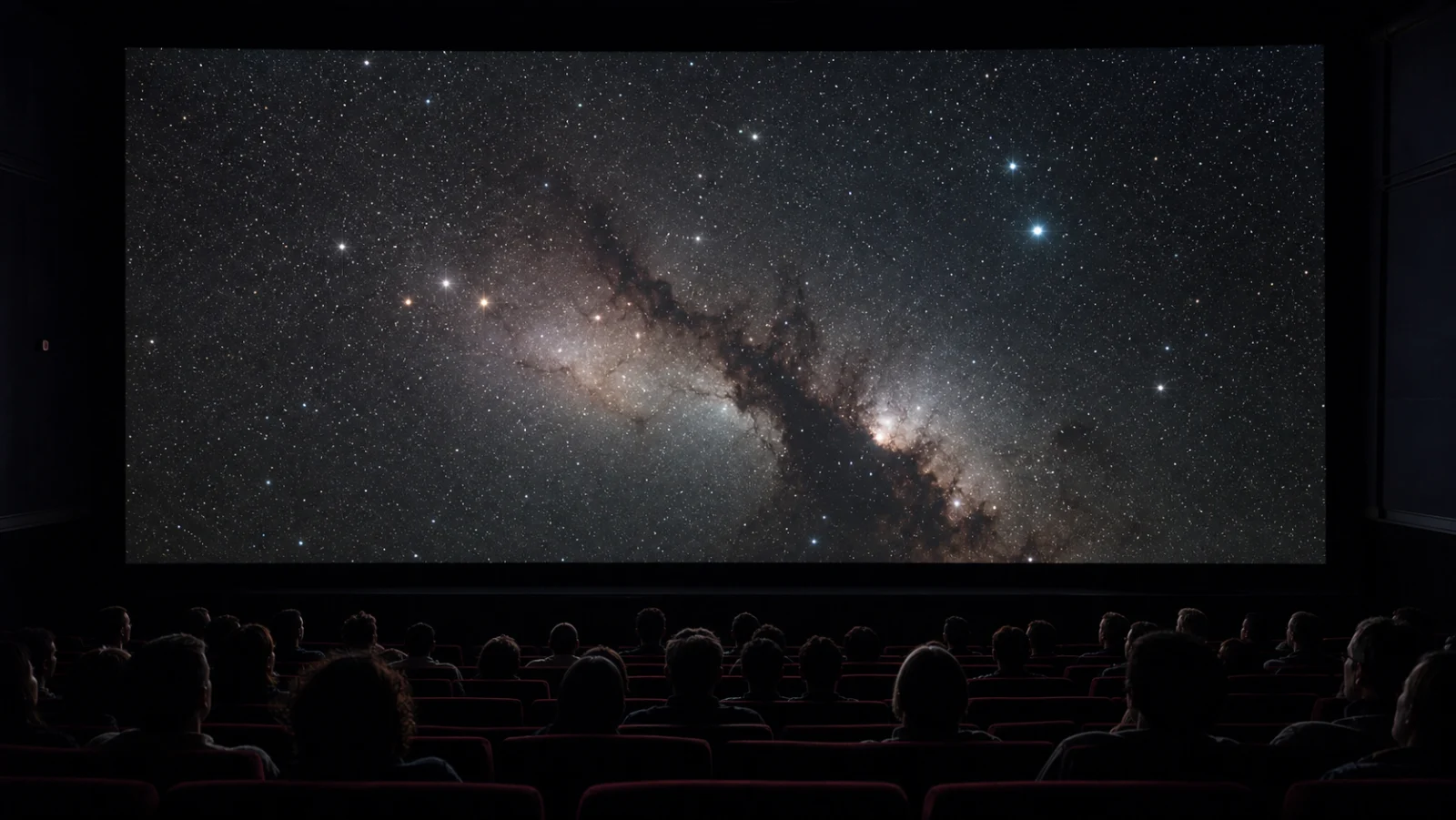
Science films face a persistent misconception: explanation drains the world of mystery. A rainbow becomes less beautiful once refraction is understood; a night sky becomes smaller when stars are described by physics; evolution replaces the drama of creation with a cold mechanism. Good scientific cinema demonstrates the opposite. Explanation changes wonder from distance into relationship. The audience does not merely admire an effect. It begins to understand the processes, timescales and evidence that make the effect possible.
For a humanist film program, science on screen has two responsibilities. It should communicate reliable knowledge, and it should make the method behind that knowledge visible. Facts without method can become another authority to memorize. Method shows viewers how claims are tested, revised and connected to a larger body of evidence.
Wonder is a beginning, not a conclusion
Wonder directs attention toward something that exceeds ordinary expectation. A fossil, cell division, distant galaxy or mathematical pattern creates the feeling that the world contains more than our current understanding. Science protects this feeling by refusing to close the question too early.
Dogmatic wonder says that mystery must remain untouched. Scientific wonder asks what can be learned. Each answer produces new questions: How old is the structure? What mechanism formed it? Does the process occur elsewhere? What observation would challenge the explanation?
Cinema can express this movement visually. A wide image establishes scale, a close view reveals structure and animation makes an invisible process available to perception. The viewer experiences wonder as a change in resolution—from impressive surface to intelligible depth.
Show the method, not only the discovery
Popular science stories often center on a breakthrough moment. A researcher sees a pattern, an instrument delivers a result and a mystery is solved. Real science usually includes repetition, failed approaches, calibration, disagreement and long periods when the answer remains uncertain.
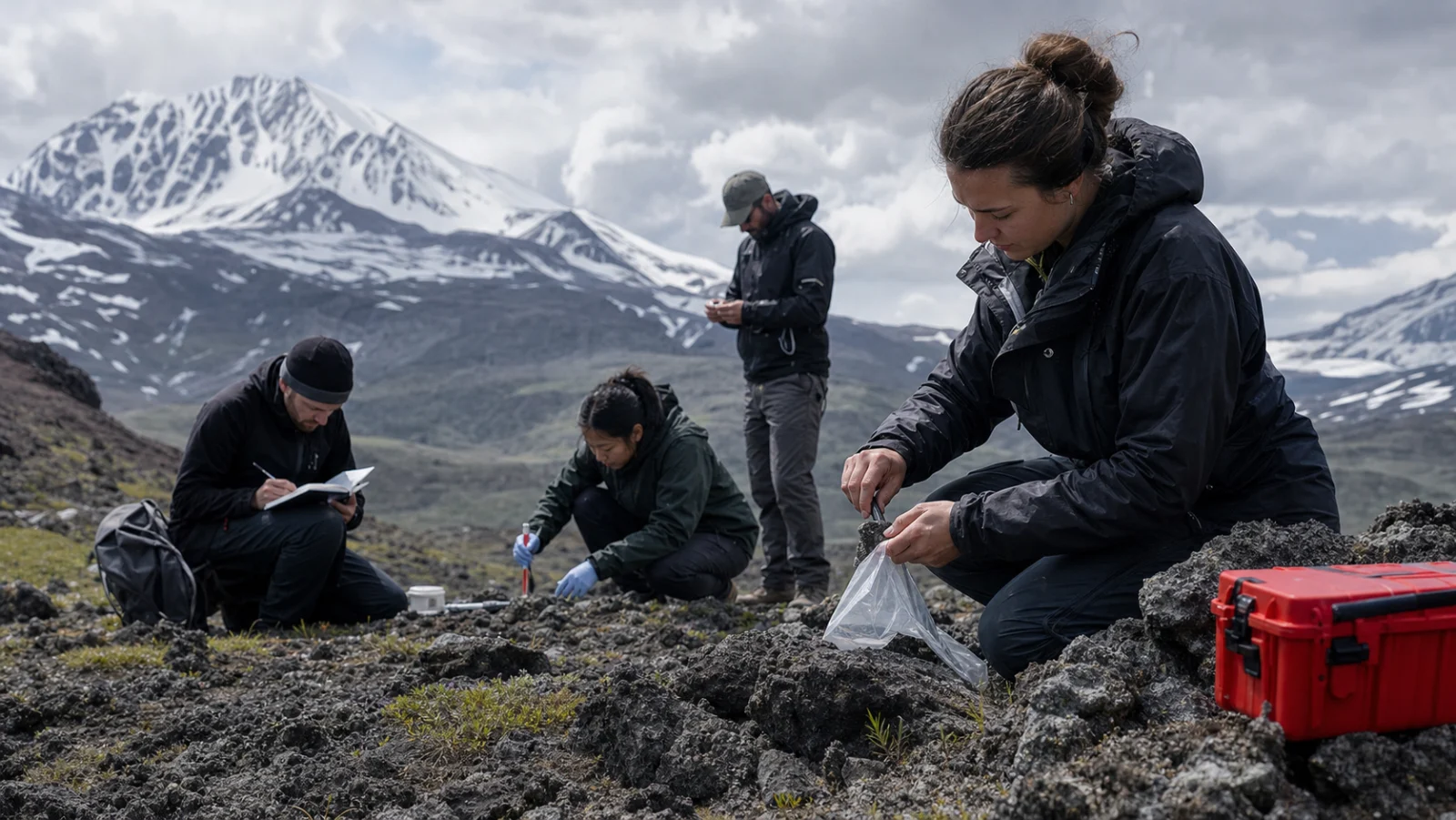
Films do not need to reproduce every technical step, but they should show enough method for the audience to understand why a conclusion deserves confidence. Who collected the data? How were competing explanations tested? Did other teams reproduce the result? What uncertainty remains?
Showing method also humanizes science without reducing it to personality. Researchers become skilled participants in a collective practice. Their imagination matters, but so do instruments, peer criticism, shared standards and the work of people whose names never become part of the discovery story.
Visualizing the invisible
Many scientific subjects cannot be photographed directly at the scale or speed relevant to the explanation. Films use models, simulations, microscopy, time-lapse imagery and data visualization. These tools are powerful because they create visual intuition, but they can also blur the distinction between observation and representation.
Responsible science cinema labels the difference. An artist’s reconstruction, computer simulation and direct instrument image should not appear interchangeable. The audience should know which features come from data and which are interpretive choices.
This transparency does not weaken the image. It teaches viewers how scientific knowledge is assembled. A model can be valuable precisely because it simplifies. The question is whether the simplification preserves the relationships necessary for understanding.
Scale is both intellectual and emotional
Science repeatedly confronts human intuition with unfamiliar scales. Geological time exceeds the span of civilizations. Cellular machinery operates below unaided vision. Cosmic distances make ordinary travel metaphors inadequate. Climate systems connect local experience to planetary patterns.
Film can bridge these scales through comparison and sequence. A landscape dissolves into ancient layers; a body becomes organs, tissues, cells and molecules; a point of light becomes a star with a history. The transition gives emotion a structure.
Scale should not be used only to make viewers feel insignificant. Human actions can be small in cosmic terms and decisive in ethical terms. A science film can hold both ideas: we are not the center of the universe, and our choices still shape the conditions of life for other beings.
Scientists are credible because they can be wrong
Public communication sometimes portrays scientific authority as certainty. This strategy can backfire when recommendations change. Viewers conclude that revision proves incompetence or deception. In reality, the capacity to revise is a source of scientific credibility.
A good film shows hypotheses being challenged and methods improving. It distinguishes uncertainty caused by limited evidence from disagreement manufactured by political or commercial interests. It explains why confidence can be high even when every detail is not known.
The language of probability deserves visual support. Ranges, scenarios and confidence levels can appear abstract, but examples can show what they mean. Uncertainty is not ignorance; it is information about the precision of a claim.
Avoid the solitary-genius myth
The image of a lone genius produces efficient drama, but it distorts how knowledge grows. Discoveries depend on technicians, students, statisticians, field workers, engineers, archivists and earlier researchers. Institutions provide instruments and continuity. Critics identify errors that insiders cannot see.
Cinema can retain compelling characters while widening the frame. A principal researcher may guide the story, but the camera can show the network around the work. Credit can be spoken, not hidden in a final list.
This matters for inclusion. When science appears to belong only to extraordinary individuals from one social background, many viewers cannot imagine participation. Showing collaboration presents science as a human practice that requires diverse skills.
Conflict should clarify evidence
Disagreement gives documentaries narrative energy. Two researchers interpret a result differently; a community challenges an institution; evidence collides with an industry narrative. But conflict can mislead when a small unsupported position is presented as equal to a broad scientific consensus.
Fairness does not require equal time for unequal evidence. It requires accurately representing the strength, relevance and independence of each position. A film should explain why one view has greater support rather than relying on titles or dramatic editing.
Conflict is most useful when it reveals method. What evidence would change each side’s view? Are they disagreeing about data, interpretation, values or policy? Separating those questions prevents scientific findings from carrying moral conclusions they cannot establish alone.
Ethics enters before the final application
Science films often reserve ethics for the last act: a discovery is made, then society must decide how to use it. Ethical choices begin earlier. Research questions reflect priorities. Funding directs attention. Study designs distribute risk. Categories can include or erase populations.
Humanist programming can invite viewers to examine these choices without turning every scientist into a symbol of power. Who benefits from the work? Who bears uncertainty? Were participants able to consent? Is knowledge available to the communities that made it possible?
Scientific accuracy and ethical care reinforce one another. Research that ignores relevant populations can produce weaker conclusions. Institutions that hide uncertainty lose public trust. Respect for people is part of reliable practice.
Nature films and the problem of narration
Wildlife cinema creates intimacy with lives that audiences may never encounter. Narration gives behavior a story, but human metaphors can distort. Animals become heroes, villains, devoted spouses or strategic politicians according to the needs of the script.
Some analogy is unavoidable; viewers need language. The discipline lies in distinguishing observed behavior from interpretation. A film can be emotionally vivid without assigning motives the evidence cannot support.
Environmental stories face a related challenge. Images of pristine wilderness may hide human communities, while images of catastrophe can produce helplessness. Effective films connect beauty, mechanism and agency. They show what is changing, why scientists know and which actions operate at an appropriate scale.
The role of humor and play
Serious science does not require solemn presentation. Humor can reduce the social fear of not knowing. Animation, experiments and playful analogies invite viewers to test an idea rather than receive a lecture.
The risk is that entertainment becomes a substitute for precision. A memorable metaphor may be carried beyond the conditions where it works. Films can protect against this by naming limits: the atom is not literally a miniature solar system; evolution does not plan; the brain is not simply a computer.
Play is most humanist when it increases participation. Viewers should leave feeling that questions are welcome and that understanding is built, not granted to a special class of people.
Watching science critically without rejecting expertise
Media literacy can drift into generalized distrust. If every image is framed and every institution has interests, viewers may conclude that expertise is only performance. This false equivalence benefits misinformation.
Critical trust asks better questions. Does the speaker have relevant expertise? Is the claim connected to published methods and independent evidence? Are uncertainties stated? Do other qualified researchers converge on the same conclusion? Has the institution corrected errors openly?
Expertise does not make a person infallible. It makes certain judgments better informed. Democratic culture needs citizens who can examine authority without pretending that all opinions begin with equal knowledge.
Programming science beside other forms
A festival can deepen scientific cinema by placing it beside fiction, biography or experimental work. A documentary about evolution may gain emotional complexity next to a drama about family and belief. A film about data can be followed by a story that shows the human consequences represented by the numbers.
These pairings prevent science from becoming an isolated category. Knowledge enters ethics, politics, identity and daily life. The conversation can distinguish what evidence establishes from what communities choose to value.
Short films are especially useful. A concise explanation can prepare an audience for a feature, while an artistic response can reopen questions after a dense documentary.
Explanation enlarges the world
The strongest science films leave viewers with more than information. They offer a changed relationship to reality. A familiar object becomes the result of deep time. A disease becomes a biological process that can be investigated rather than a moral judgment. A night sky becomes evidence arriving from different eras.
This change is profoundly humanist. Meaning does not require the universe to be designed around us. It can arise from our capacity to understand, care and act within a reality larger than ourselves.
Wonder survives explanation because reality remains inexhaustible. Each reliable answer gives the imagination firmer ground. Science on screen can make that ground visible: not a cold world emptied of mystery, but a shared world in which questions lead somewhere.