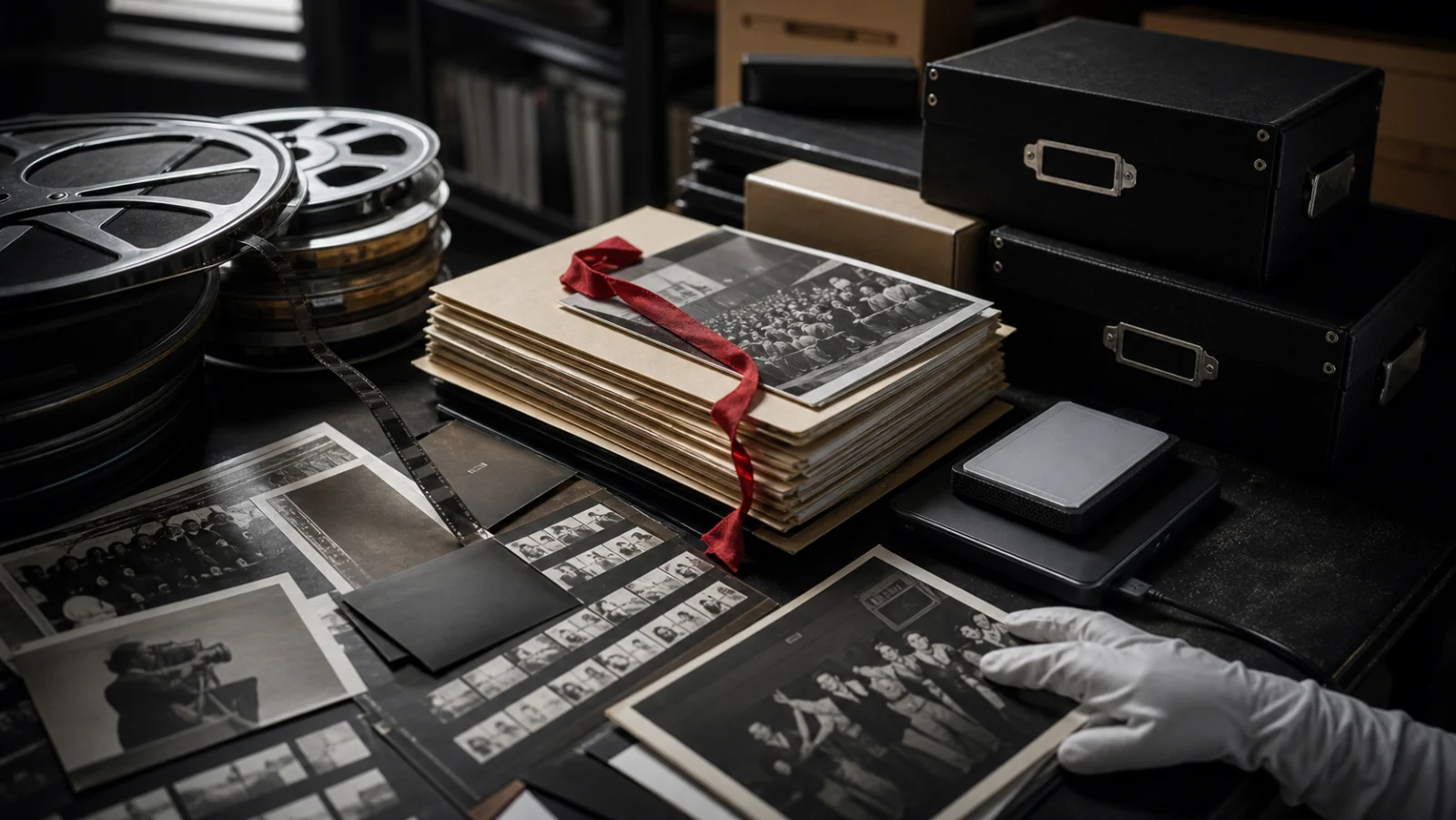
A festival website can look permanent until it vanishes. Hosting expires, software breaks, domains change owners and image services remove files. Pages that once served practical tasks—schedules, submissions, directions—become cultural evidence only after the event is gone. By then, the materials may be incomplete.
Preserving a digital film festival archive requires more than saving screenshots. An archive should retain structure, routes, dates, relationships and uncertainty. It should help a future visitor understand what the site did, which information is verified and what no longer belongs to an active service.
Define the authentic scope
Domains can have several lives. An original festival site may later host unrelated commercial posts, automated content or a different organization. Preservation begins by defining the period and materials that belong to the cultural record.
Dates, branding, organizations, venue references and archived navigation help establish scope. A change in content management system or topic is evidence, but not every early page is automatically authentic.
The archive should publish its criteria. This prevents curation from appearing neutral and allows correction when new evidence emerges.
Preserve URLs as historical identifiers
An old path is more than a technical address. It appears in programs, emails, reviews and other archives. If the path disappears, those references lose their connection.
Case-sensitive legacy routes can be especially important. Rebuilding them allows citations and bookmarks to resolve. When two old URLs describe the same material, redirects can consolidate authority while preserving continuity.
Routes that are authentic but no longer functional—submission or volunteer forms, for example—should remain as historical pages that clearly state the activity is closed. Recreating an active-looking form would distort the record and create privacy risk.
Separate capture from interpretation
A web capture records a page as it appeared to an automated crawler at a particular moment. It may miss scripts, images, downloads or pages hidden behind interaction. The capture is evidence, not a complete replica.
A renewed archive adds interpretation: summaries, context and relationships among surviving items. These additions should be distinguishable from period text. Visitors need to know when a statement comes from an original page, a contemporary report or present-day reconstruction.
Labels such as “documented,” “corroborated,” “archive note” and “not verified” create an honest vocabulary.
Build a provenance trail
Every important fact should have a source pathway even if the public page does not display a formal citation beside every sentence. The archive can maintain internal notes identifying captures, media listings, organizational records and filmmaker pages.
Provenance protects against accidental invention. It also makes updates efficient. When a date is challenged, editors can review the evidence rather than rebuilding the research.
For generated database content, source fields and update timestamps help distinguish editorial history from event history. The database is part of the archive’s method, not proof of the underlying claim.
Keep uncertainty visible
Incomplete records create pressure to make the archive feel finished. A missing timetable may be reconstructed from titles and dates until the result looks plausible. This is dangerous because design can give speculation the appearance of authority.
An honest archive preserves gaps. It can state that a date-specific route is authentic while the exact screening order remains unverified. It can list films known to belong to an edition without inventing times.
Uncertainty is useful information. It tells future researchers where additional programs, emails or personal collections could improve the record.
Store structured data, not only pages
Static HTML is resilient and easy to serve, but structured data makes a growing archive manageable. A SQLite database can store articles, routes, dates, images, captions and publication status in a portable file.
The database should have a documented schema, unique slugs and explicit relationships. Images belong in a separate table or structured field so their order, alt text and captions remain connected to the article.
Static pages can then be generated from SQLite. This approach combines reliable delivery and search-engine accessibility with a queryable editorial source. The public site does not need to expose the database file.
Use formats that can survive
Preservation favors open, documented formats. UTF-8 text, HTML, CSS, SQLite, XML, JSON, PNG and WebP are broadly readable. Proprietary project files may be retained, but they should not be the only copy.
Fonts and scripts should be self-hosted where licenses permit. External dependencies can disappear or change. A site that needs a third-party service to display its basic content is harder to preserve.
Generated pages should remain meaningful without client-side JavaScript. Progressive enhancement is welcome; dependence is a risk.
Treat images as records with rights
Festival photographs, posters and film stills may have different owners. A web archive must not assume that historical availability grants unlimited reuse.
Each image should have a source, rights status, descriptive alt text and caption. If the archive uses a newly generated editorial image, it must be labeled so visitors do not mistake it for documentation of the event.
Missing images are preferable to false evidence. Design can use typography, rules and clearly interpretive visuals without claiming an invented photograph is historical.

Preserve the social context
A schedule tells what screened. It does not explain who organized the event, how tickets were priced, which organizations partnered or why the program mattered locally.
Context can be reconstructed through sponsor pages, staff lists, radio interviews, venue records and contemporary descriptions. These materials show the network that made the event possible.
The archive should avoid turning every name into an endorsement. Organizations and roles may have changed. Historical language needs clear temporal framing.
Distinguish inactive services from live ones
Old festival sites contain operational language: buy tickets, submit a film, donate, volunteer, contact the team. Restoring these pages without modification can mislead visitors.
Historical pages should state that prices, addresses and calls to action are archival. Forms should be removed or disabled, especially if no organization is prepared to receive personal data.
This clarity protects users and strengthens trust. An archive is not less authentic because it refuses to imitate obsolete transactions.
Design for retrieval
Archives are used differently from campaign sites. Visitors arrive through specific titles, dates and old links. Navigation should support browsing by edition, subject and route while search engines receive canonical URLs and a complete sitemap.
Page titles and descriptions should name the festival and historical scope. Structured data can identify the site as an archive, festival record and collection of articles.
Internal links matter. A date page should connect to the edition overview; an award page should connect to the relevant program; a blog essay should point back to primary archive sections.
Backups need a restoration test
A backup is only a promise until it can be restored. Archives should keep dated copies of source, database and public output in more than one location. Checksums can confirm that important files transferred without change.
The restoration process should be documented: which command rebuilds the site, which file is the SQLite source and which directories contain images. Dependencies should be pinned.
Occasional test builds reveal missing assumptions before an emergency. Preservation is a maintenance practice, not a single export.
Corrections are part of preservation
An archive becomes stronger when former organizers, filmmakers and audience members can identify errors or contribute material. A correction pathway should explain what evidence is useful and how rights concerns are handled.
Changes need an editorial record. Updated dates and provenance notes make revision visible without presenting every edit to casual visitors.
The archive should resist confident memories when they conflict with contemporary evidence, but it should also recognize that official pages can contain mistakes. Sources require evaluation, not worship.
Protect the archive from new noise
An expired cultural domain can attract mass publishing because old links carry value. Unrelated posts then obscure the authentic history in search results.
Restoration should remove this material, return genuine not-found responses for invented routes and use gone responses for known spam sections. A clean sitemap helps search systems rediscover the intended scope.
The archive should not publicly obsess over SEO mechanics. Its strongest signal is coherent, verified content at stable URLs.
Preservation is an ethical claim
Choosing what to preserve says what deserves memory. Small volunteer festivals can disappear because they lacked institutional staff, not because they lacked cultural significance. Restoring them corrects an imbalance in the record.
The work should remain modest about what survives. A beautiful interface cannot replace lost photographs or complete schedules. It can make the remaining evidence legible and protect it from further loss.
A successful digital festival archive lets visitors move from a remembered link to a trustworthy context. It keeps the event historical without making it inert. The films, questions and community relationships become available again—not as a simulation of an active festival, but as durable material for future thought.
Plan for stewardship beyond the first rebuild
A restored archive can disappear a second time if responsibility remains attached to one person or one computer. The project needs a small succession plan. At minimum, two trusted stewards should know where the source, SQLite database, domain settings and backups are kept. Recovery instructions should be readable by someone who did not build the site.
Stewardship also needs boundaries. Editors should know which changes require evidence, how a rights request is evaluated and when a historical page should be corrected rather than silently replaced. Automated article generation should never publish directly into the archive without editorial review.
Periodic maintenance can remain modest: confirm that the domain resolves, run the build, check a sample of legacy URLs, review dependency updates and create a fresh off-site backup. A yearly audit may be enough for a stable static archive.
Succession protects more than infrastructure. It protects judgment. The reasons for preserving certain routes, excluding unrelated content and labeling generated images should survive the original team. Without that context, a future redesign may accidentally erase the very distinctions that made the archive trustworthy.