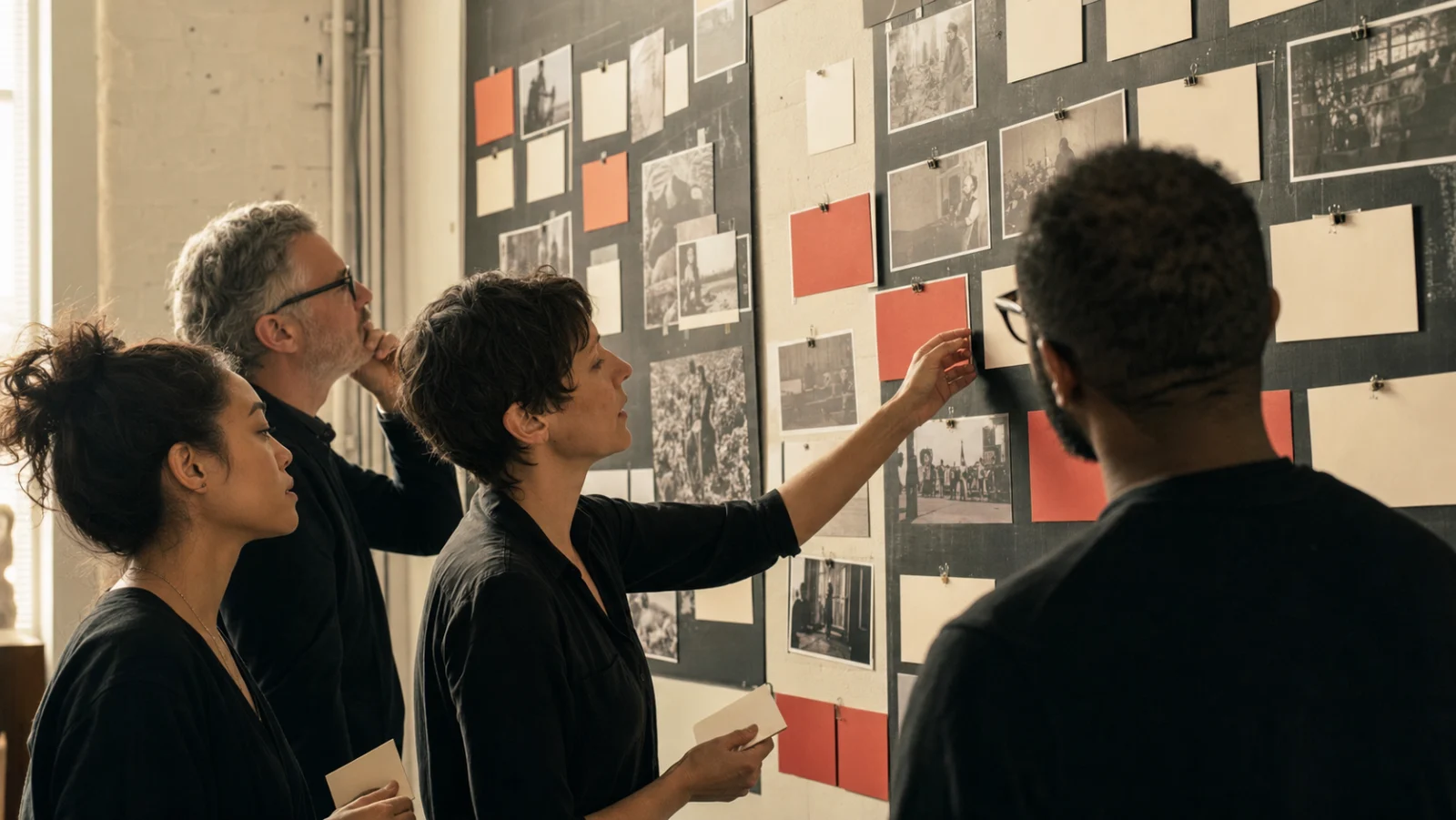
Curating a humanist film program is not a search for ten films that repeat the same values. A strong program creates relationships among works that differ in form, tone and conclusion. It gives audiences evidence, stories, humor, discomfort and enough space to think. Humanism supplies an orientation—reason, dignity, freedom of inquiry and responsibility—but curation turns that orientation into an experience.
The program must work intellectually and physically. Titles need rights and viable formats. Audiences need breaks, context and accessible venues. A film that is perfect in isolation may fail in a sequence. Programming is therefore the art of selection, relationship and rhythm.
Begin with questions, not categories
Categories such as science, belief, ethics and human rights help organize research, but they can produce predictable blocks. Questions create more dynamic programs. What does evidence demand from us? How do people change a belief? When does loyalty become complicity? What makes a life meaningful?
A question can connect a documentary, drama, animation and short film without pretending they make the same argument. It also invites audiences who do not identify with a philosophical label.
The curatorial team should write a brief statement of inquiry for each strand. If a film does not sharpen, complicate or productively resist that inquiry, its relevance may be superficial.
Define the audience honestly
“General audience” is not a useful description. Programmers should identify likely viewers, missing viewers and practical barriers. Is the festival speaking mainly to an existing humanist community, students, families, filmmakers or curious neighbors?
An insider program can assume more context but risks becoming repetitive. A public-facing program needs accessible entry points without treating audiences as intellectually passive.
Language, ticket cost, screening time, captions and transportation are part of audience definition. A festival cannot claim broad invitation while designing every practical detail for one group.
Build range without losing coherence
Humanist cinema includes more than documentaries about religion. A program can explore scientific discovery, civil liberties, migration, disability, education, environmental responsibility, grief, comedy and ordinary moral choice.
Range should not become a list of worthy topics. Coherence comes from recurring questions and deliberate adjacency. A film about data may be paired with a character-driven story showing the lives represented by the data. A satire can expose certainty after a serious documentary examines its consequences.
Program notes should explain relationships without prescribing interpretation. The audience deserves an invitation, not an answer key.
Balance argument and experience
Some films make explicit claims. Others create a situation that resists summary. A festival built entirely from issue documentaries can become exhausting and rhetorically flat.
Narrative and experimental work allow audiences to encounter ambiguity. Comedy can reveal dogma through timing and contradiction. Animation can make abstract science emotionally accessible.
Balance does not mean equal quantities of every form. It means varying how the audience is asked to think. After receiving dense information, viewers may need a work that engages perception, character or imagination.
Evaluate evidence and form together
A documentary aligned with humanist values can still use weak evidence or manipulative editing. Agreement with the conclusion should not lower standards.
Programmers can review source transparency, treatment of uncertainty, representation of opposing claims and consent. They should also evaluate cinema: structure, image, sound, pacing and whether the film earns attention rather than relying only on importance.
Selecting a film signals trust. If a work has limitations worth discussing, the program can frame them openly rather than presenting the screening as endorsement.
Treat representation as an editorial method
Diversity is not a final count added after selection. It changes which questions appear and what evidence the program notices. Filmmakers from affected communities may frame agency, history and solutions differently from outside observers.
The curatorial team should examine who speaks, who is looked at and who receives complexity. A program about universal human dignity that repeatedly centers the same social perspective contains a contradiction.
Representation also includes disability access, class, age and geography. No single edition can include everything, but exclusions should be visible to the team rather than accidental.
Use shorts strategically
Short films are not filler before a feature. They can establish a question, provide contrast or introduce a local voice. A concise science explanation may prepare viewers for a narrative; a poetic short may reopen emotion after a data-heavy documentary.
Shorts also broaden participation because emerging filmmakers and formally experimental work can enter the program. Their rights and technical needs still require professional care.
Avoid assembling a shorts block only because the films are brief. Give the sequence its own arc and enough time for discussion.
Design the day as an emotional sequence
Viewers have finite attention. Three films about violence in succession may produce numbness rather than commitment. A difficult work needs context and recovery.
Programmers can map intensity, duration and cognitive demand. A lighter film does not trivialize serious material if the relationship is thoughtful. Humor can restore openness and expose absurdity.
The final screening of a day carries special weight. It may leave the audience with urgency, agency, wonder or unresolved tension. Choose that effect intentionally.
Invite speakers for contribution, not prestige
A recognizable name can attract attention, but the relevant question is what the speaker adds. Lived experience, local knowledge, research expertise and filmmaking craft are different contributions.

Speakers should understand the discussion format and time limit. A screening should not become a platform for an unrelated presentation. Moderators need enough preparation to connect the guest’s knowledge to specific moments in the film.
Compensation, access and travel should be considered early. Invitations based on goodwill alone reproduce unequal participation.
Handle controversial work with intellectual courage
Free inquiry requires exposure to difficult claims, but controversy is not a curatorial virtue by itself. A film deserves inclusion when it offers evidence, artistic value or a perspective important to understanding the question.
Programmers should distinguish challenge from dehumanization. A work can criticize religion, politics or social practices forcefully without treating people as inherently contemptible.
Context can prepare audiences without neutralizing the film. Content information, program notes and skilled moderation allow serious engagement while respecting participants.
Make accessibility part of selection
Captions, audio description, readable subtitles and available transcripts affect whether a film can be programmed responsibly. Retrofitting access at the last moment may be impossible.
The screening copy should be tested in the venue. Subtitle size that works on a laptop may fail on a large screen. Sound mixes can make dialogue difficult even for hearing audiences.
If access is incomplete, communicate clearly and keep improving. Honest limitations are better than surprise barriers.
Research rights and formats early
Curatorial ambition can collapse when rights are unavailable or a film exists only in an unusable format. Contact distributors, filmmakers and archives before public announcement.
Agreements should cover date, venue, capacity, ticket terms, promotional materials and whether recording is permitted. Historical films may require restoration sources and specific projection standards.
Technical testing is part of respect for the filmmaker and audience. Aspect ratio, frame rate, audio channels and subtitle files should be confirmed, not assumed.
Write program notes that open the door
Effective notes provide context, not plot summary. They can identify the central question, explain why films are paired and name historical details necessary for understanding.
Avoid claiming that a film “proves” a broad moral conclusion. Give viewers room to encounter form and disagreement. Notes should also distinguish archival fact from current editorial interpretation.
Plain language is not simplistic language. The strongest notes are precise enough for experts and welcoming enough for first-time visitors.
Build discussion into the schedule
If conversation is part of the festival’s purpose, it needs time. A ten-minute gap that also includes bathroom lines and venue reset is not a discussion slot.
Some films need immediate dialogue; others benefit from a break. Programmers and moderators should decide together. Audience questions may connect across a day, so later introductions can recall earlier themes without assuming everyone attended.
Resources and local connections can be offered after the discussion. The screening should not end with an unexamined call to action.
Document the program for the future
Preservation begins before opening night. Keep final schedules, rights metadata, program notes, accessibility details and credits in structured form. Save stable image files and record their rights status.
A SQLite database can support future publication and correction, while static pages preserve fast public access. Authentic URLs should remain stable after the event.
Document changes. A replacement film, altered time or canceled speaker is part of the historical record, not an embarrassment to erase.
Measure success beyond attendance
Ticket counts matter for sustainability, but a humanist program has other goals. Did new audiences attend? Were discussions substantive and inclusive? Did viewers encounter unfamiliar work? Were filmmakers and speakers treated well?
Feedback should ask specific questions rather than requesting generic satisfaction scores. Volunteers and venue staff often notice operational problems that surveys miss.
Success may include a smaller room with genuine exchange, a corrected assumption or a partnership that continues. Scale is not the only evidence of value.
Curating a practice of curiosity
The final program should feel like an invitation to think with others. It can be confident about standards without pretending that every film reaches the same conclusion. It can hold scientific rigor, moral imagination, artistic risk and pleasure in one weekend.
Humanist curation is therefore less about assembling approved messages than about designing encounters. Films meet one another; audiences meet unfamiliar lives; evidence meets emotion; disagreement meets a structure capable of holding it.
When those relationships are carefully built, the festival becomes more than its schedule. It becomes a temporary culture of curiosity—one that viewers can carry into the decisions, institutions and conversations waiting outside the cinema.